
Thursday, September 24, 2026
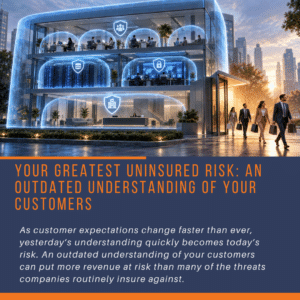 Why outdated customer understanding may be your company’s greatest uninsured risk.
Most companies insure their buildings, their data, their executives, and increasingly, their cybersecurity. They do so because they understand a simple truth: the cost of being wrong can be catastrophic.
Yet there is another risk that receives remarkably little attention despite being far more likely to damage a business than a fire or flood.
Making strategic decisions based on an outdated understanding of your customers.
For decades, businesses could afford to let customer intelligence age. Markets evolved gradually, competitors changed slowly, and customer expectations moved at a manageable pace. Annual surveys, occasional client visits, and conversations with the sales team were often enough to keep leaders reasonably aligned with reality.
Today’s environment is fundamentally different.
Artificial intelligence is reshaping buyer expectations. Economic uncertainty is forcing organizations to reevaluate priorities. Buying committees continue to expand, procurement has become more sophisticated, and new competitors emerge with surprising speed. The market is changing faster than many organizations can process.
Ironically, the people making the buying decisions haven’t changed nearly as much.
Customers still want to reduce risk. They still seek trusted advisors. They still respond to credibility, empathy, competence, and confidence. Human nature hasn’t been rewritten.
What has changed is the environment surrounding those decisions. Buyers face more information, more options, more internal stakeholders, and more uncertainty than ever before. That means the assumptions that were true a year ago, or even six months ago, may no longer hold.
The Most Dangerous Sentence in Business
When Anova begins research programs, we often hear the phrase: “We think our customers want…”
In my twenty-five years of experience, I’ve learned that few mindsets are more costly. Not because leadership lacks intelligence or experience, but because markets now move faster than assumptions.
In recent conversations with leadership teams, I’ve seen this pattern play out repeatedly: executives are rarely far off because they lack insight. They are off because the market has moved faster than their last direct conversation with a customer. The gap is often subtle at first. A shift in urgency, a new stakeholder in the buying process, a different definition of value. But those small changes can have major strategic consequences.
A recent client meeting underscored just how costly that gap can become. After we reviewed candid customer interviews with the executive team, I asked a direct question: did this feedback reflect what they believed their customers were experiencing? The CEO was thoughtful. He acknowledged that, if asked to list the top ten issues customers cared about, this concern would have been on the list. But he also admitted it would not have been anywhere near the top. What surprised the team was not that the issue existed. It was the intensity behind it, the consistency of it across customers, and how clearly it had begun to shape their perception of the relationship.
As organizations grow, senior leaders naturally become further removed from day-to-day customer conversations. Dashboards replace dialogue. Reports replace relationships. Customer feedback becomes filtered through multiple layers before it reaches the executive team.
Eventually, even well-intentioned organizations begin making decisions based less on what customers are saying and more on what they believe customers are saying.
The Cost of Not Knowing
For many organizations, customer research is still treated as an occasional initiative. A survey is fielded. A series of interviews is conducted. Findings are presented. The report is filed away until the next project.
That approach made sense when markets were relatively stable.
Today, customer understanding is no longer a periodic exercise. It is an executive capability. Customers don’t stand still. Neither do competitors. Customer understanding has become a capability not an event.
The organizations we work with that are pulling away from their competitors aren’t necessarily the ones with the biggest research budgets. They’re the ones creating continuous feedback loops that keep leadership connected to reality. Every conversation becomes another opportunity to validate assumptions, identify emerging risks, and uncover opportunities before competitors do.
Voice of Customer isn’t simply about measuring satisfaction. It’s about reducing uncertainty. It’s your early warning system. It tells you where expectations are changing before your revenue does.
The Cost of Waiting
Executives rarely lose sleep because they haven’t conducted enough customer interviews. They lose sleep over declining retention, slowing growth, losing strategic accounts, unexpected competitive losses, longer sales cycles, stalled innovation, and unexpected customer departures.
By the time those problems appear on a dashboard, the underlying shift in customer perception has often been underway for months. Customer perception changed long before the financial metrics did.
Voice of Customer doesn’t eliminate uncertainty. No strategy can. But it dramatically reduces the chances that leadership will make critical decisions while operating from an outdated picture of the market. Voice of Customer doesn’t simply explain what happened. It helps you see what’s happening now. And, in many cases, what will happen next.
The Greatest Uninsured Risk
Every leadership team is making bets:
The businesses that thrive over the next decade won’t be those with the loudest opinions. They’ll be the ones with the clearest view of reality.
Every business protects itself against unlikely events. The next step is protecting against a far more common one: making confident decisions with an outdated view of the customer. The question for leadership teams is not whether they know their customers. Most do. The better question is whether what they know is still current enough to guide the decisions they are making today.
In a world moving this quickly, current customer understanding is not a research luxury. It may be one of the most valuable forms of insurance a company can have.

© 2026 Anova Consulting Group, LLC. All rights reserved