
Thursday, March 26, 2026
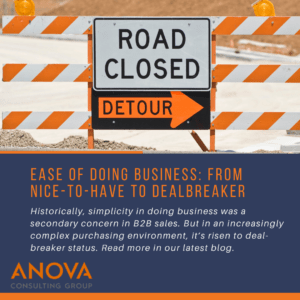 Written by Research Analyst Jeffrey Cheng, this is the third in a series of blogs that will explore the four themes identified by Partner Andrew Cloutier driving the state of voice-of-the-customer research in 2026.
In many B2B markets, the ease of doing business has shifted from a secondary consideration to a decisive factor in purchase decisions.
Historically, Anova’s Win/Loss Analysis and Voice of the Customer (VOC) programs revealed a familiar story: vendors won because their product capabilities were stronger, their pricing more competitive, or their brand more credible. Friction in areas like onboarding or contracting was often tolerated if the perceived value justified the effort.
Today, that story is changing.
Across industries, buyers increasingly evaluate vendors through a different lens: How difficult will it be to implement, integrate, and manage this solution?
Win/Loss interviews show this concern surfacing repeatedly, often late in the buying process. Buyers may recognize strong capabilities yet still choose a competitor that feels easier to adopt. In many cases, that perception is shaped less by the product and more by how well the sales team anticipates and reduces friction throughout the journey.
Critically, these concerns are rarely voiced directly during active sales cycles. As a result, many organizations underestimate their impact. Anova’s research increasingly shows that many deals are lost not because the solution was weaker, but because the overall buying experience felt harder.
Understanding where this friction occurs, and how effectively sales teams can manage it, has become a critical source of competitive intelligence.
Why is Ease of Doing Business Growing as a Concern?
Enterprise purchasing has become significantly more complex. Decisions now involve cross-functional buying groups spanning procurement, legal, IT, finance, and operations. Each group introduces new requirements and risk considerations.
In this environment, the role of sales has evolved. It is no longer just about positioning value; it is about orchestrating a seamless buying process.
Sales teams must align stakeholders, anticipate objections, and coordinate internal resources to keep deals moving. Even small breakdowns can have outsized impact:
Individually, these issues are manageable. Together, they signal something more concerning: Working with this vendor will require effort. When buyers anticipate effort, they also anticipate risk.
Anova’s Win/Loss Analysis frequently surfaces this insight. Deals that are competitive on product and price can stall or fail when operational complexity introduces doubt, particularly when sales teams are unable to proactively simplify the experience.
The Rise of “Conversion Aversion”
In addition to the growing bureaucratic and procedural hurdles, an additional dynamic emerging as increasingly important in our Win/Loss programs is conversion aversion, or the reluctance organizations feel when switching vendors.
Change requires coordination across stakeholders and often demands political capital from internal champions. As a result, incumbent vendors frequently enjoy a structural advantage, even when challengers offer superior solutions.
While this has always been a concern in complex sales processes, increasingly this conversion aversion has become increasingly difficult to surmount – in part due to the dynamics described above.
Win/Loss interviews often reveal buyers caught between interest and hesitation. Buyers may express strong interest in a new solution while simultaneously worrying about the implementation burden. When sales teams do not address these concerns early and consistently, the status quo prevails.
This raises the bar for sales. Winning now requires more than a compelling value proposition. Sales teams must actively reduce the perceived cost of change by simplifying the path forward to align stakeholders early.
How Sales Teams Can Help Manage this Changing Dynamic
Your sales teams are on the front lines of this shift. They translate internal complexity into a coherent external experience, guiding buyers through evaluation while managing expectations and momentum.
Perspective is critical here: internal teams grow accustomed to established processes, while customers encounter them for the first time.
Ease of doing business is not owned by a single function. It is shaped across sales, legal, security, product, finance, and customer success. That said, sales teams are uniquely positioned to connect these functions and shape how buyers experience them.
Sales teams set the tone early by establishing expectations for stakeholders and surfacing risks before they become blockers. It also acts as the integrator, ensuring internal teams align to deliver a seamless experience.
When this coordination breaks down, customers feel it immediately.
Leading organizations recognize this and treat ease as a strategic capability. They equip sales teams with:
Just as importantly, they invest in Win/Loss Analysis and Voice of the Customer programs to continuously identify where friction exists and how it impacts deal outcomes.
These insights are critical for sales leaders. They reveal where deals are being lost due to avoidable complexity, where enablement is needed, and where cross-functional alignment can improve win rates.
Over time, longitudinal analysis allows organizations to track whether changes are reducing friction and strengthening competitive performance.
Conclusion: Ease of Doing Business is the New Competitive Advantage
In many markets, product differentiation is narrowing. Buyers increasingly assume a baseline level of functionality across vendors.
The calculus behind choosing a new vendor has shifted:
Instead of asking, Does this solution work?
Buyers increasingly ask, How much work will this create for our organization?
Sales teams are the first to hear that question and the most responsible for providing answers. Organizations that succeed will be those that empower their sales teams to remove friction at every stage of the buyer journey, while aligning the broader business to support that effort.
Win/Loss Analysis and Voice of the Customer insights provide the visibility needed to do this effectively, linking buyer perception to revenue outcomes and guiding where to act.
Because in today’s B2B environment, being great is no longer enough.
You also have to make it easy.

© 2026 Anova Consulting Group, LLC. All rights reserved